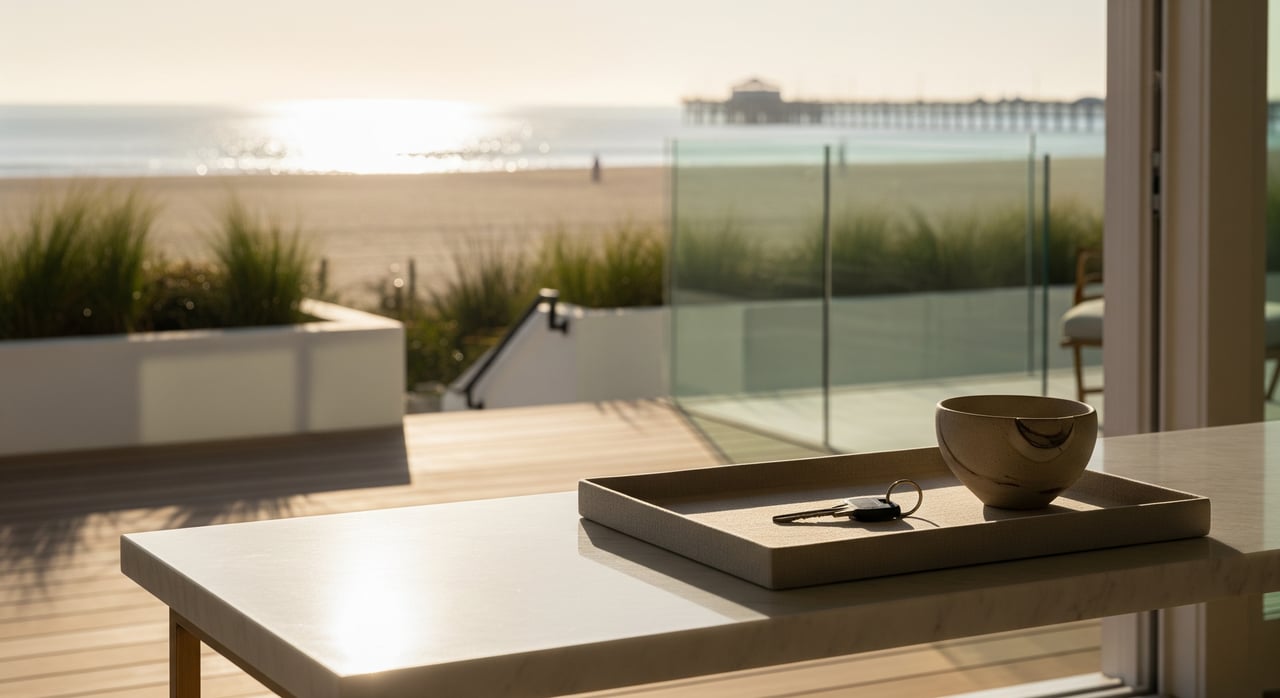
Walk to the end of the Hermosa Beach Pier this month and look down at your feet. Some of the bronze Surfers' Walk of Fame plaques are gone from the deck, and the ones that remain are on their way to the railings instead. The city is moving them because water has been seeping through the plaque mounts into the concrete below, corroding the rebar that holds the pier together. It is a small, almost decorative change. It is also the most visible sign yet of a much larger decision the city has not made.
The pier is not about to collapse. An engineering report delivered to the City Council in March rated the structure "poor to serious," but the near-term repairs needed to keep it safe and open are already funded and underway. The real risk to the pier is not structural. It is a calendar problem, and the calendar is the part almost nobody outside City Hall is tracking.
What the Engineers Actually Found
JMC2 Engineering, the firm the city hired to assess the pier, laid out three paths for the Council at its March 24 meeting. None of them are cheap, and none of them are simple.
- Keep repairing the pier on its current five-year inspection cycle indefinitely. Total cost over the next 45 years: roughly $210 million.
- Replace the pier outright. JMC2 priced that at $58.6 million, not including financing, which a resident watchdog at the meeting estimated could add another $45 million.
- Remove the pier. This option was raised from the public comment podium and picked up by a councilmember, but it never gathered real support.
Public Works Director Joe SanClemente framed the tradeoff plainly for the Council: a cycle of constant repairs, or a full replacement. Either way, the pier that opened in 1965 has reached the point where deferring the choice costs real money. The 1965 structure is itself the third pier Hermosa Beach has built. The first was a wooden pier approved by a 24 to 23 vote in 1904, two years before Hermosa incorporated as a city. A storm destroyed it in 1913, and the city rebuilt in concrete a year later, then again in 1965 after that structure aged out. The pier residents walk today has already outlived its two predecessors combined. Whatever the city decides now sets the terms for its fourth chapter, or its last.
The Part of the Vote That Didn't Happen
At that same March meeting, the Council voted unanimously to fund $3.7 million in high-priority repairs, the work now scheduled for this fall. That part is settled. What is not settled is everything after it.
Councilmember Rob Saemann introduced a motion directing staff to begin the process toward full pier replacement by 2032, and Mayor Mike Detoy seconded it. Mayor Pro Tem Michael Keegan pushed back in the same meeting, saying he could not move forward without a real conversation about how the city would pay for it. "We're a City Council, not the federal government," he said. That tension, replace now or figure out funding first, is still open. No subsequent Council meeting through September has taken it up as a scheduled action item.
Resident Laura Pena put the stakes to the Public Works and Parks and Recreation Commissions in blunt terms in May: "I don't think a lot of people realize that we could possibly lose this. And if we have to make a decision by the end of 2026, you need to get the public's attention on this."
Here is why her timing matters. SanClemente told commissioners the city needs to give formal direction by the end of 2026 to keep a 2032 groundbreaking on the table. Miss that window, and the next opportunity doesn't arrive until 2030, pushing construction out to 2036, and locking the city into another roughly $4 million round of interim repairs in the meantime. The clock is not metaphorical. It is a specific administrative deadline with a specific financial penalty for missing it, and as of this month, the item has not appeared on a single Council agenda since the spring.
Why the City Keeps Punting
The hesitation is not political theater. It is arithmetic. Administrative Services Director Brandon Walker told commissioners the city needs $8 to $12 million a year for basic citywide infrastructure repair, but is only replenishing its General Fund reserves at $4 to $6 million a year. COVID relief money, staff vacancy savings, and deferred projects propped up capital spending for a while, but Walker was direct that those sources are gone. "There is no consistent structural General Fund support for capital projects," he said.
That gap explains why a decision that sounds urgent in a commission meeting keeps getting workshopped instead of voted on. It also explains the interest in outside funding. Parks and Recreation Commissioner Traci Horowitz asked SanClemente about the Piers Reinvestment Act, a bill introduced by Congressman Robert Garcia that would let coastal cities use federal infrastructure funds on piers specifically, something current law excludes in favor of bridges. SanClemente called the bill "exciting news," but it has not passed, and the city is not building a budget around a maybe.
The Council That Has to Decide Might Not Be the One That Started It
Here is the detail that gets lost in coverage of the pier's engineering report: the five people who have been debating this all year are not guaranteed to be the five people who finish the conversation. Hermosa Beach holds its general municipal election on November 3, 2026, for three of the five Council seats. Two of the current members weighing the pier's future, Ray Jackson and Dean Francois, are in seats up for election this fall.
That means the "end of 2026" deadline SanClemente described falls just weeks after voters could seat one, two, or three new Council members. Whoever wins in November inherits a decision that was supposed to be resolved before they are sworn in, or ends up making it themselves in their first weeks on the job. Residents who care about how this gets decided have a more direct form of input this year than a public comment card: their ballot.
What Changes on the Pier This Fall
None of this changes what residents will actually see over the next few months. The city plans to carry out the approved $3.7 million repair package after the summer crowds thin out, with work beginning in September or October and continuing through the winter. The scope includes replacing four concrete deck panels outright and repairing fourteen more to stabilize the walkway, along with the plaque relocation already underway. Expect some sectioned-off stretches of decking and possible short closures during the work, the same kind of disruption the pier absorbed during its last major repair push in 2024, which cost $3.1 million.
None of that touches the bigger question. The Surfers' Walk of Fame, the Sunday concerts on the sand south of the pier, the volleyball tournaments on the north side, all of it continues on the pier the city already has. What is genuinely uncertain is what that pier looks like in ten years, and whether the decision gets made on schedule or gets kicked, again, to a Council that has not yet been elected.
Why This Is Worth Watching Even If You Never Set Foot on It
The pier is the kind of civic fixture that people notice only when it changes. Councilmember Saemann said as much in March: the pier is part of what makes Hermosa what it is and should never be removed. Resident Eric Horne put it in generational terms at the same meeting, framing the choice as whether this Council saves the pier, loses it, or passes the decision to the next one. That is not hyperbole. It is a fair description of what SanClemente's timeline actually requires.
We think about stewardship the same way when it comes to the homes and land we help families manage on the Palos Verdes Peninsula and across the South Bay. The decisions that protect a property, or a landmark, for the next generation are rarely dramatic. They are budget lines, inspection reports, and calendar deadlines that are easy to miss until the window closes. If you are weighing a decision of your own on the Peninsula, whether it is timing a sale, understanding what a piece of land is really worth, or simply making sense of what is changing in the neighborhoods you care about, Mackenbach Group is glad to talk it through. Request a private consultation whenever you are ready.